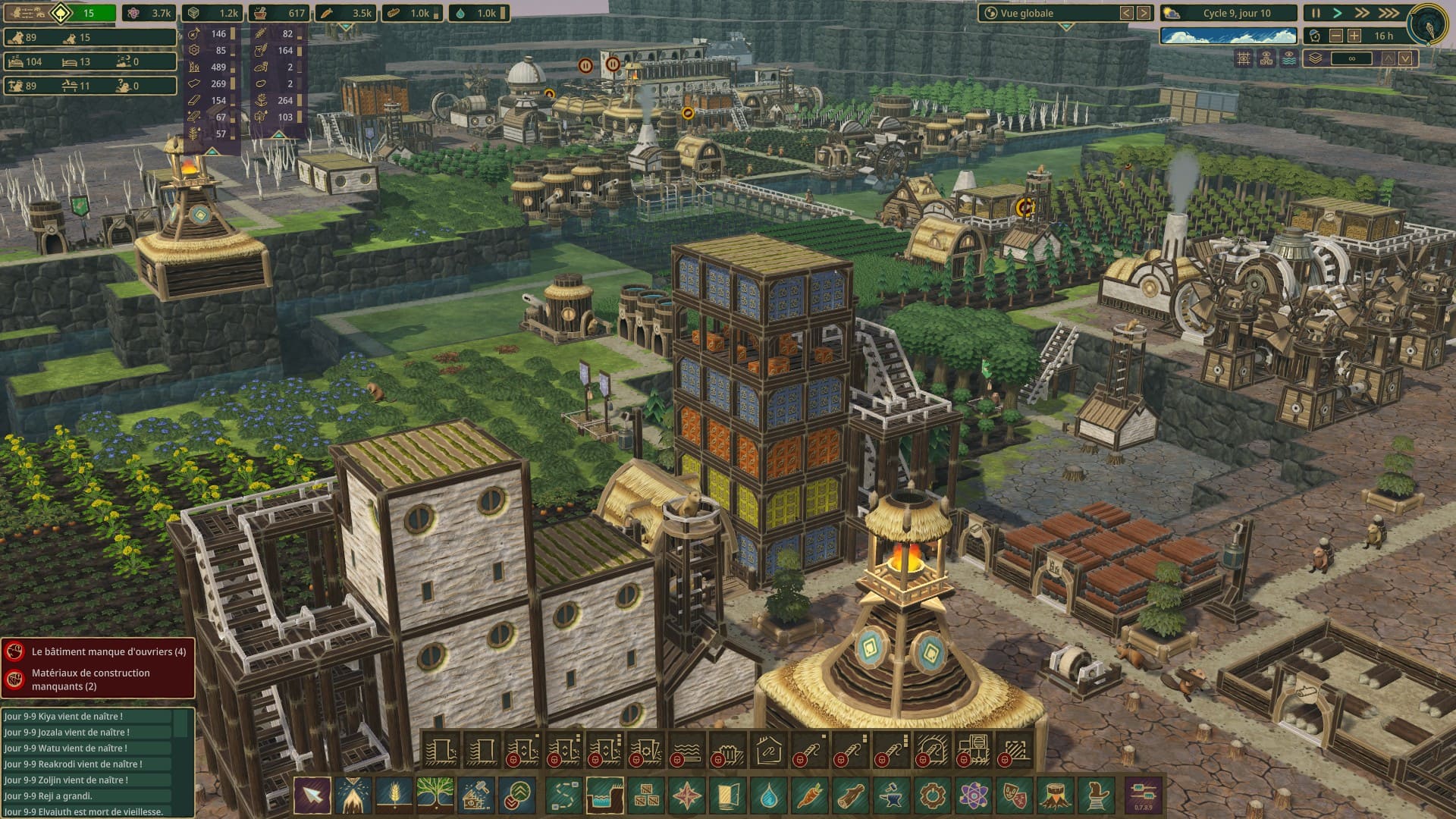
Les castors du monde entier sont en liesse. Le 12 mars, Timberborn sort en 1.0 après 4 ans et demi d’accès anticipé ! Ce simulateur de colonie fort sympathique gagne encore en profondeur grâce à l’ajout de nouvelles mécaniques et de l’automatisation, ici très poussée. En utilisant la vingtaine de relais et de capteurs fraîchement arrivés, vous pouvez dorénavant programmer votre ville pour tout gérer de façon automatique. Cela va même plus loin puisque les développeurs ont intégré des leviers et adaptateurs HTTP, qui permettent d’agir sur le jeu depuis l’extérieur et inversement. Les ingénieurs n’ont pas fini de ronger des arbres…
Page steam | Tarif : 34€ | Mon test
Changelog de Timberborn 1.0 concernant l’automatisation :
- New feature: Automation. Most of the new buildings are found in this new category on the toolbar.
- New building: Lever Flipped manually – either via the building panel or a pinnable UI element – this is the most basic way of sending a signal. For example, you could use a single Lever to turn on multiple Lumber Mills at once.
- Added new key bindings (unassigned by default) that you can use to activate pinned Levers.
- New building: Relay . Performs simple logical operations on its input signals (NOT, OR, AND, XOR, Passthrough). This way, for example, you can make Pumps turn on only when there is sufficient water depth AND your tanks are getting empty.
- New building: Flow Sensor . Checks the water flow speed below its sensor.
- New building: Depth Sensor. Checks the water depth below its sensor.
- New building: Contamination Sensor. Similar to the one above, this one checks the water contamination level below the sensor.
- New building: Chronometer. Sends a signal based on the time of day. This includes a custom range as well as whether it’s work time or leisure time.
- New building: Weather Station. You may have it send a signal when a particular season (or seasons) is in progress.
- New building: Power Meter. Monitors power network parameters – supply, demand, surplus energy, and the charge percentage of connected batteries.
- New building: Population Counter. Checks the district or global population of a certain type (like a number of bots, unemployed beavers, contaminated kits etc.).
- New building: Resource Counter. Checks the quantity or fill percentage of a particular good in the district it’s connected to. Meet the criteria, and the signal is sent.
- New building: Science Counter. This one is pretty self-explanatory.
- New building: Indicator. A large cuboid that lights up. Use it to make certain information (as in: certain input signals being active) easier to notice. In addition to being visible in the game world, you can also pin it in the UI, and even make it add journal entries or show a warning when switched on.
- New building: Speaker. You may have it play music (or anything, really – you can add custom sounds, even some that would make Gary Oldman laugh until he cries). Music will play when the input signal is active – either once or continuously. You may also make it play within the game world, around the speaker, or make it heard globally.
- New building: Firework Launcher. If you needed a visually pleasing reward for your automation shenanigans, here’s one! The Firework Launcher is now in the game, allowing you to shoot fireworks of customizable style and frequency.
- New building: Detonator. And if you are really into explosions, hook up the Detonators to your Dynamite. As soon as the input signal comes through, your beavers will start blastin’.
- New building: Timer. With the Timer, you can modify other signals, for example by delaying them or triggering an oscillation signal instead. The Timer can be set to reset at a certain condition.
- New building: Memory. Now we’re talking! With Memory modules, you can create the most advanced automation setups – for example, a Memory can switch on when one signal comes through and then reset after receiving another.
- New building: HTTP Lever. It’s like a Lever but can be switched on and off or recolored via API. Either you or your programmer friend will find a good use for it. The high science cost is only paid once and unlocks the building for all your future settlements.
- New building: HTTP Adapter. Exposes the on and off state of in-game signals via API and makes webhook calls. Or, in hooman-speak, with a moderate amount of tinkering, it can light up your IRL light bulb when your beavers are low on water. The science cost is also paid only once for all your settlements.